Swapping manual spreadsheets for an automated CRM or Applicant Tracking System (ATS) is one sign of a growing recruitment agency. However, even otherwise innovative agencies can be slow to bring their phone call management up to speed. If your team are still using personal mobiles, voicemail, Post-it notes and shouting across the office to find out if a client has been called back or not, there’s a good chance you’ve outgrown manual call handling.
Find out what you could be missing – in terms of both candidate satisfaction and agency revenue – and how you can maximise the potential of your incoming and outgoing calls with Talenta AI phone system.
Calls are the bottleneck many recruitment agencies ignore
Think back to why you replaced spreadsheets and that sense of immediate liberation that followed. No more cross-referencing client and candidate records against the database, poring through a stack of CVs, or manually updating vacancies and statuses.
An ATS takes care of the repetitive admin and a CRM slashes the time it takes to find and update records. Recent AI tools have streamlined processes even further, allowing busy agents to create multiple reports or vacancies with a single prompt. That gives back time to your team for revenue-generating activities like prospecting and lead development.
However, there’s a missing link in the chain when your calls don’t feed into the system. And if you’re still managing calls manually, that’s almost certainly the case.
6 symptoms of call-handling that’s holding your agency back
Not sure if you need a smarter phone system? Ask yourself how long your agency can continue to sacrifice revenue and opportunities to these common weaknesses…
1. You can’t tell who’s called, or been called
If the only way to consult the call logs is to be back in the office, verbally checking in with the rest of the team, then your agents are essentially trying to make progress with the brakes on. Think of the time saved when you can pull up a current list of all incoming, outgoing and missed calls, as well as voicemail messages that need a follow-up.
2. Consultants are searching for caller records during the call
If you can’t see who’s calling before you pick up, or access their records until the conversation is underway, you’re always playing catch-up. And if you need to physically go over to a filing system to find the records, you’re distracted too.
3. Call notes live in personal inboxes, notebooks or nowhere at all
Each agent will have their preferred system for keeping track of their client and candidate progression. Slack channels, Gmail inboxes, Word documents or manually written notes on a desk pad. It’s a leaky way to manage data even if everyone is working efficiently, but becomes almost impossible to navigate when, for example, one agent has to search information in another recruiter’s system. Think of how many “quick” searches end prematurely with access denied or password not recognised.
4. Missed calls disappear into individual handsets instead of a shared list
Think of all the calls coming in out of hours or during busy periods, and where those names and numbers are recorded. Typically, the information is scattered across individual team members and therefore reliant on their timetable for scheduling a reply. The ideal scenario is to feed all missed calls into a central database where they can be assigned automatically to an available team member for fast follow-up. Add their full records to the note and the system runs seamlessly.
5. Two people are chasing the same candidate without knowing it
It’s embarrassing for the agent and infuriating for the client or candidate, but it’s completely avoidable. From the moment a new caller enters the database, the agency should have a system for tagging their progress and assigning a team member to manage their file.
6. Managers have no visibility into call volume, outcomes or consultant performance
Whether it’s across a single office or a regional or national chain, the business grows faster when leadership can see what kind of requests are coming in, how many are converting into opportunities and placements, what the most common objections or blockers are, and which high-performers should be paired with the most profitable opportunities. The CRM might give a clue, but it’s the call history that really offers the insight.
Warning: Inefficiency scales as the agency grows
A minor fissure in call handling quality becomes an expensive crack to repair as the number of consultants, offices and calls increases. The system struggles, the gaps grow bigger, and before long revenue is flooding through the holes, usually in the direction of competitors with more robust systems in place.
How to fix the gap between phone and CRM
The last mile might be the hardest mile, but the first call can be where most agencies make the misstep that topples their momentum.
With a smart AI phone system such as Talenta, however, the gap between phone call and CRM is sealed, strengthened and streamlined.
Calls connect automatically to the correct candidate/client record in the CRM
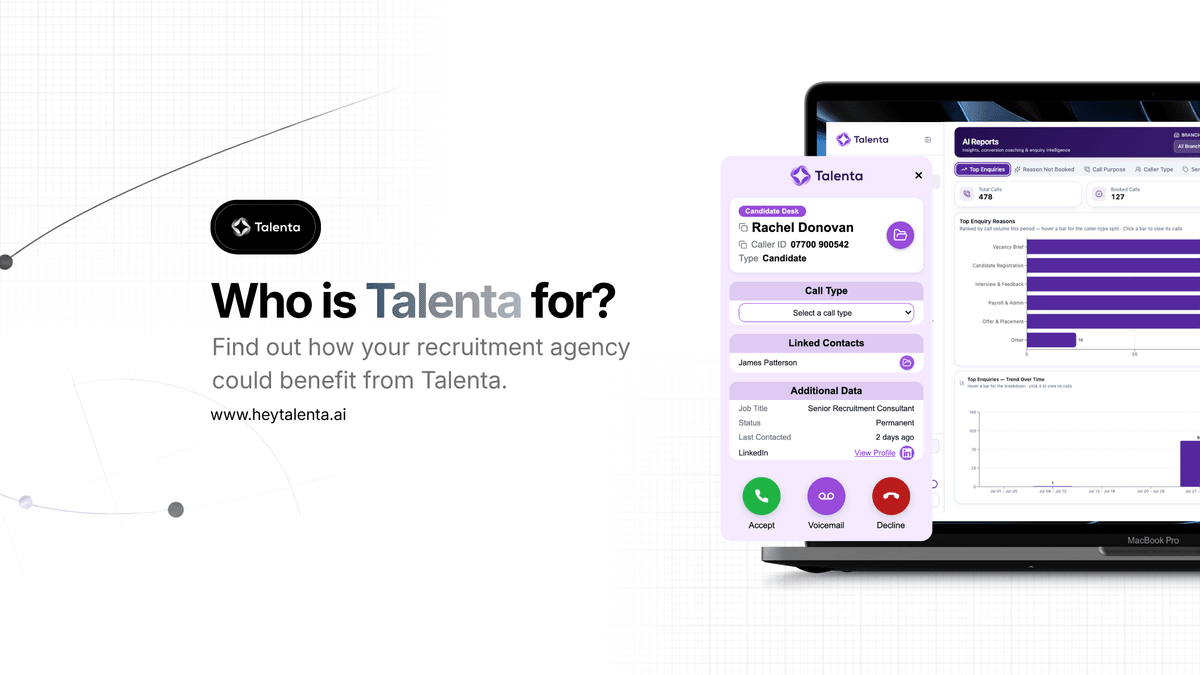
Talenta automatically records every call and posts a full transcript, summary and conversation analysis to the CRM when the call ends. It works both ways, too. When an incoming number is from a returning caller, the system pulls the record from the CRM and displays it on an on-screen pop-up while the phone is still ringing, giving the agent a welcome head start.
Notes, summaries and next steps sync to the CRM without manual entry
Recruiters spend hours every week updating call notes into the CRM. It saps time and introduces the possibility of errors entering the system. By contrast, Talenta posts everything automatically without any human input required. That’s the kind of smart AI in action that recruiters have been waiting for.
Missed calls are visible and trackable
In a hyper-competitive job market, the value of a missed call increases, as does the likelihood that the person on the other end will go elsewhere if they don’t get a quick callback. With Talenta, everything is logged in a central database and assigned for follow-up, so nothing is missed. Managers can track callback rates too, in order to check that the team is on target.
Consultants get context before they even pick up
In an ideal world, every incoming call would be an opportunity. Unfortunately, the current recruitment landscape means that a large proportion of calls are from frustrated, stressed, distraught or demanding clients and candidates. Having to answer every one cold takes a toll on the recruiter, too. With Talenta, the caller details are visible immediately on an on-screen pop-up, so not only can the recruiter greet them by name, automatically lowering any tension, but they can also start the conversation where matters left off, rather than wasting time establishing the basics.
How Talenta connects your calls to the systems you already use
Talenta integrates with the CRM systems top agencies are already using, like Firefish and Bullhorn, so it’s a simple set-up, no rip and replace.
Add these features to the benefits you’re already getting from your CRM:
- Smart caller pop-up
- Automatic call transcription, summaries and notes posted to the CRM
- Missed call tracking
- Team performance management
Ready to close the gap in your communications?