Most recruitment agencies know how many calls their consultants make and receive. Far fewer know what those calls actually produce. Recruitment agency call tracking helps agencies understand how many conversations lead to interviews, candidate registrations, new vacancies or other valuable outcomes.
A standard phone report may show total calls, average duration and how many went unanswered. Those figures explain how busy a desk or office was, but they do not show whether candidates progressed, interviews were arranged or callers became genuine opportunities.
What is recruitment agency call tracking?
Recruitment agency call tracking is the process of recording and analysing incoming and outgoing calls.
Basic reporting normally shows the caller’s number, which office or consultant they contacted, the call duration and whether anyone answered.
More advanced recruitment call analytics can connect calls with CRM records, candidates, clients, vacancies, inquiry types, interviews, outcomes, follow-up actions and conversion rates.
This moves reporting beyond how many calls took place and shows what those conversations achieved.
Why basic recruitment call reports are not enough
A busy desk is not always a productive desk.
One agency may handle 500 calls and arrange 50 interviews, while another may handle 340 calls and arrange the same 50 interviews. If management only reviews call volume, the first agency appears busier. However, when managers measure conversion, they can see that the second agency produces more value from fewer calls.
Traditional reports also treat very different conversations equally. A supplier checking an invoice, a temporary worker querying a timesheet and a hiring manager calling about a new vacancy may each count as one incoming call, even though their commercial value is very different.
Effective call tracking should separate routine service calls from new business opportunities and show how each inquiry was handled.
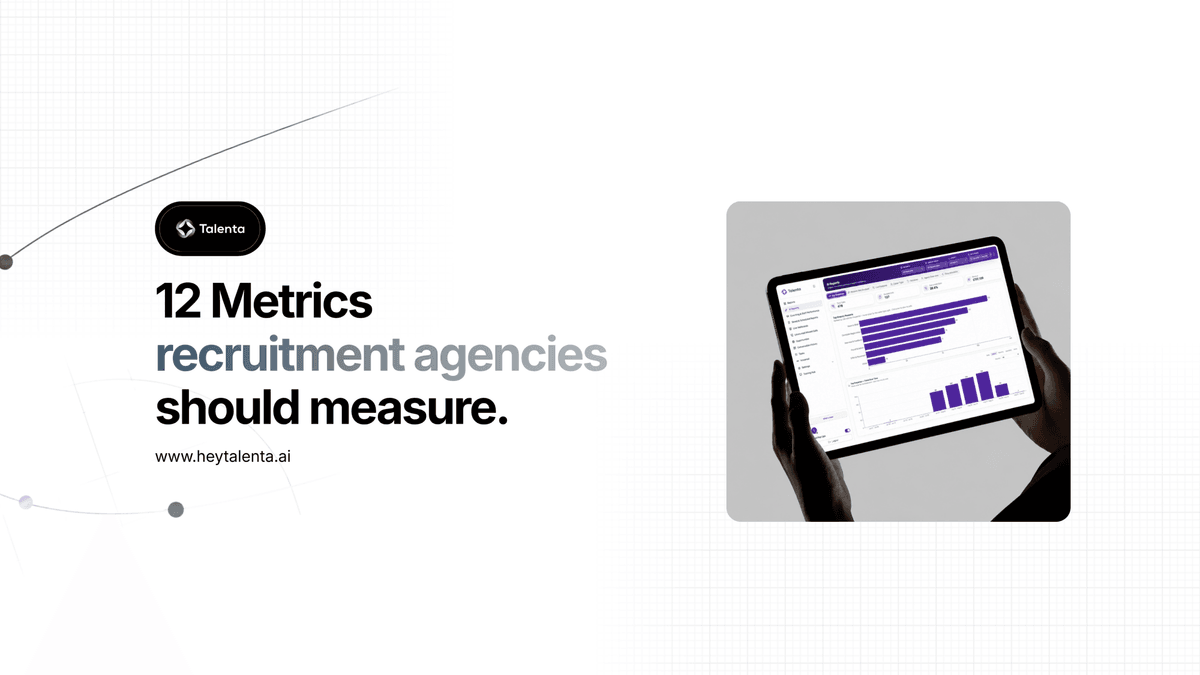
Here are 12 call metrics every recruitment agency should measure.
1. Total incoming and outgoing calls
Call volume provides a useful overview of activity across the agency.
Incoming call data can show when demand is highest, which offices and desks receive the most calls and whether activity increases after a job advert goes live or a marketing campaign launches.
Outgoing calls can show how actively consultants are following up candidates, hiring managers, clients and temporary workers.
However, call volume should only provide context. More calls do not automatically mean more interviews or placements.
2. Call answer rate
Call answer rate measures the percentage of incoming calls answered by the agency.
A low answer rate may indicate limited coverage, poor routing, busy periods without overflow support or calls being sent to consultants who are already on the phone or in interviews.
Answer rates should be reviewed by office, team, day and time. An acceptable monthly average could still hide a high number of missed calls during lunch, early in the morning or after 5pm, when many candidates are finally free to return a call.
An answered call is not automatically a successful call, but answering is the first step towards converting the inquiry.
3. Missed calls
A missed call occurs when nobody at the agency answers an incoming call.
Agencies should be able to see when it happened, which office or consultant the caller tried to reach and whether the CRM already contains the caller’s details.
It is also important to separate total missed calls from unique callers. One candidate calling several times should not automatically be counted as several different opportunities.
However, repeated attempts may indicate urgency or frustration, such as a candidate trying to confirm an interview or a client chasing a shortlist, and should remain visible to the team.
4. Unreturned and unresolved calls
A missed call and an unreturned call are not the same thing.
A missed call shows that the agency did not answer initially. An unreturned call shows that the agency did not successfully respond afterwards.
Reporting should distinguish between an attempted callback, successful contact and a resolved inquiry.
A call should not disappear from the follow-up list simply because one unsuccessful callback was made.
This metric helps managers identify opportunities that still require action.
5. Response and callback time
Response time measures how quickly the agency engages with an inquiry.
For answered calls, this may refer to how long the caller waited. For missed calls, it is the time between the original call and the callback.
Instead of relying only on one average, agencies should track how quickly teams return calls, such as within 15 minutes, one hour, the same day or the following day.
This makes delays easier to identify and gives teams a clear service target. In recruitment, speed matters: a strong candidate who waits until tomorrow for a callback may already be talking to another agency.
6. New callers and existing contacts
Not every call represents new business.
A useful recruitment call-tracking system should distinguish between first-time candidates, registered candidates, active applicants, existing clients, prospective clients, temporary workers and suppliers.
This helps managers interpret call volume more accurately.
An office may receive a high number of calls because it manages a large temporary workforce, with regular shift and timesheet queries. Another may receive fewer calls but a greater proportion of new client and vacancy inquiries.
Understanding who is calling gives the activity more useful context.
7. Reason for the call
Knowing that a call took place is less useful than knowing why the person called.
Common inquiry types include questions about a role, application updates, interview arrangements, candidate registrations, new vacancy inquiries, interview feedback, offer discussions, shift availability and timesheet or payroll queries.
Categorising calls helps agencies understand demand across teams and sectors and identify which inquiries are arriving outside office hours.
It also allows managers to separate new business opportunities from service and administrative calls.
8. Call outcome
The call reason explains what the caller wanted. The outcome explains what the agency achieved.
A call about an interview might result in an interview being arranged, a callback, an unsuccessful transfer or no interview being offered.
A new vacancy inquiry may become a confirmed client meeting, remain unresolved or be identified as outside the agency’s sector or area.
Outcome tracking allows managers to see whether calls are being progressed rather than simply answered.
Agencies should use a clear, focused set of outcomes that reflect their real recruitment processes.
9. Inquiry-to-booking conversion rate
Conversion rate measures the percentage of relevant inquiries that become an interview, meeting or another desired result.
For example, an interview conversion rate should compare interviews arranged with qualified candidate inquiries about live roles.
A new business conversion rate should compare booked client meetings or vacancies taken with qualified new client inquiries.
Conversion should not be calculated using every call received, as this would include suppliers, timesheet queries and unrelated conversations.
Using relevant inquiries provides a more accurate picture of how well consultants and offices turn demand into action.
10. Booked and unbooked opportunities
Conversion rates show the percentage of inquiries that progressed. Booked and unbooked reporting shows the volume behind that percentage.
An agency may receive 40 new vacancy inquiries, book 28 client meetings and leave 12 unbooked.
Those 12 inquiries may not all represent lost opportunities. Some callers may not be ready to hire, may recruit outside the agency’s sectors or may already be working with another agency.
However, some may remain unbooked because no consultant was available, the consultant did not ask for the meeting or the required follow-up did not happen.
Recording the reason helps managers identify capacity problems, process gaps and coaching opportunities.
11. Consultant and branch conversion performance
Call analytics can help managers compare performance across consultants, branches and teams.
Useful measures include interview conversion, new business conversion, callback time, missed-call follow-up and unresolved inquiries.
These comparisons should always be considered in context. A business development consultant handles different calls from a candidate-focused delivery consultant, and some sectors or offices receive stronger leads or have more live vacancies.
The purpose should be to recognise effective behaviours and identify where additional support is required, rather than create an unfair league table.
12. Revenue connected with call outcomes
The most commercially useful reporting connects inquiries, interviews and vacancies with potential or actual revenue.
This may include estimated placement fees from new vacancies, potential fees linked to unbooked opportunities and revenue performance by consultant, branch or sector.
Managers should use estimated revenue as a performance indicator rather than treat it as guaranteed income. A vacancy does not always become a placement, and a placement can still fall through before or after the candidate starts.
However, attaching an estimated value helps managers understand the commercial impact of missed or unconverted opportunities.
Twelve unbooked client meetings are easier to overlook than the potential placement fees those meetings could have represented.
What should a recruitment agency call dashboard show?
A useful call dashboard should make problems and opportunities easy to identify.
Team leaders and branch managers need a daily view of missed calls, unresolved inquiries, outstanding callbacks and interviews or meetings booked.
Weekly reporting can show call demand, answer rates, inquiry types, conversion performance and changes from the previous week.
Directors may need a monthly view covering interviews, client meetings, conversion rates, booked and unbooked opportunities, estimated revenue and branch or sector trends.
The reporting period should reflect the action required. A team leader needs to know which candidates and clients need a call back today, while a director needs to understand whether commercial performance is improving over time.
Common recruitment call-tracking mistakes
One common mistake is measuring activity without measuring results. Total calls and call duration describe workload, but they do not show whether the conversations produced interviews, vacancies or placements.
Agencies should also avoid treating every call equally. For example, they should analyse new vacancy inquiries differently from supplier calls.
Another mistake is marking calls as complete after one unsuccessful callback attempt. Managers need to know whether the team successfully contacted the caller and resolved the original inquiry.
Reports should also lead to action. If nobody follows up a call, improves a process or provides coaching because of the data, the agency may be collecting information without using it.
How AI improves recruitment call tracking
Traditional call tracking records what happened around the call. AI call analysis can help explain what happened during it.
An AI phone system can transcribe conversations, identify why someone called, create summaries and extract agreed next steps.
It may also detect interview and appointment outcomes, analyse caller sentiment and highlight calls that require follow-up.
This reduces reliance on consultants manually categorising every conversation and allows managers to search for calls based on their content.
AI analysis should support management judgement rather than replace it. Managers still need to consider the context of each conversation and make sure performance reviews remain fair.
How Talenta provides call tracking for recruitment agencies
Talenta is an AI Phone System and AI Receptionist platform built specifically for recruitment agencies.
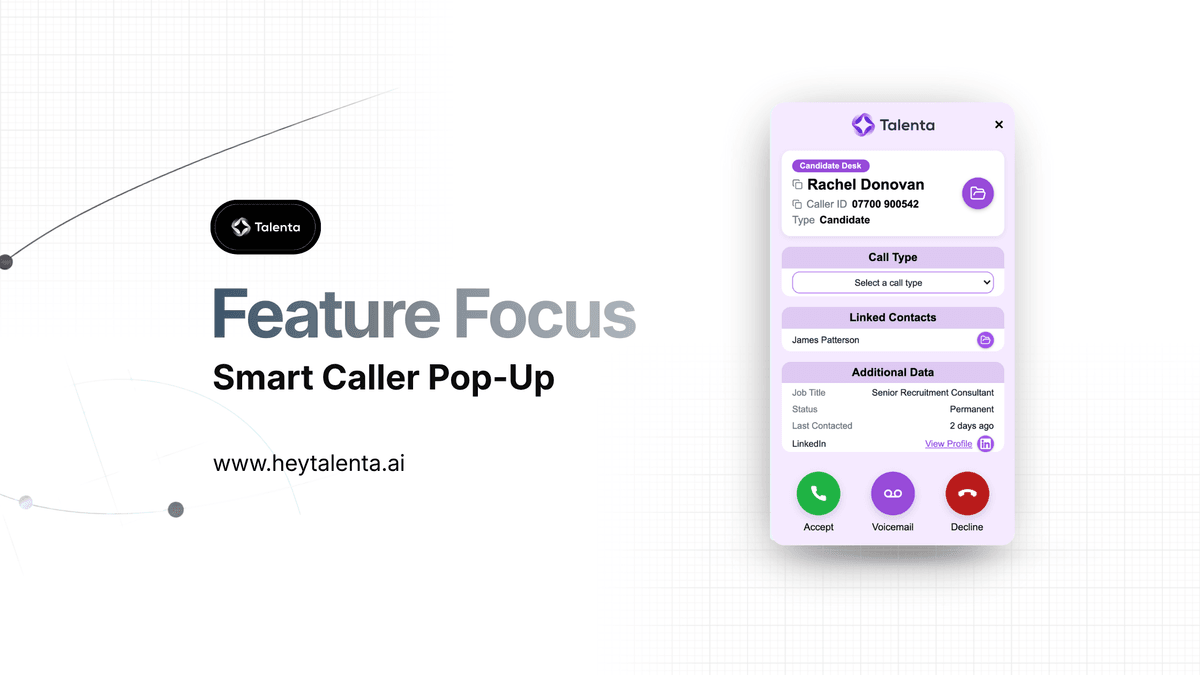
Before a call is answered, Talenta can display caller information through its recruitment CRM integrations, including Bullhorn and Firefish. A Smart Caller Pop-Up helps the consultant see who is calling, view linked vacancies and open the relevant candidate or client record in one click.
During the conversation, calls can be recorded, transcribed and analysed. Important details, next steps and caller sentiment can be identified automatically.
After the call, Talenta creates an AI-generated summary and can sync relevant notes with the agency’s CRM.
The Talenta Intelligence Dashboards give agencies greater visibility into total call volumes, answered and unanswered calls, missed and unreturned calls, inquiry types, interview and appointment bookings, conversion rates and booked and unbooked opportunities.
Managers can also review estimated revenue, consultant and branch performance, caller sentiment and potential coaching opportunities.
For agencies that need additional call-answering capacity, the Talenta AI Receptionist can answer approved inquiries, collect information and book interviews or appointments when consultants are busy or the agency is closed.
Agencies can use the Talenta AI Phone System and AI Receptionist separately or combine both products to support calls handled by consultants and calls answered by AI.
Move beyond basic phone reports
Recruitment agencies do not generate revenue simply by handling more calls.
Value is created when conversations result in candidate registrations, interviews, new vacancies, client relationships and completed placements.
Call volume still matters, but it is only the beginning.
Effective recruitment agency call tracking connects each conversation with its caller, purpose, outcome and next action.
It helps managers move beyond asking:
“How many calls did the team handle?”
Instead, they can ask:
“Which calls created opportunities, which opportunities converted and what can we improve next time?”
That is the difference between a basic phone report and genuine recruitment call intelligence.
See how Talenta can turn your agency’s calls into clear actions, measurable outcomes and commercial insight.
Book a live demo and free quotation today.
Frequently asked questions
What is recruitment agency call tracking?
Recruitment agency call tracking records and analyses incoming and outgoing calls. More advanced systems can connect conversations with CRM records, candidates, clients, vacancies, interviews and commercial outcomes.
Which call metrics should recruitment agencies measure?
Recruitment agencies should measure call volume, answer rates, missed calls, unreturned calls, callback times, inquiry reasons, call outcomes, conversion rates and booked versus unbooked opportunities.
Why is call volume not enough?
Call volume only shows how busy an agency is. It does not show whether calls resulted in interviews, new vacancies or placements.
What is a recruitment call conversion rate?
A call conversion rate measures the percentage of relevant inquiries that become a desired outcome, such as an interview arranged or a client meeting booked.
How does AI improve recruitment call reporting?
AI can transcribe calls, identify inquiry types, create summaries and detect outcomes or follow-up actions. This gives managers greater visibility while reducing manual administration.
Can recruitment call tracking connect with a CRM?
Yes. A CRM-integrated phone system can connect callers, vacancies, notes, recordings and outcomes with the correct candidate or client record. Available features depend on the CRM integration.