Talenta’s AI phone system offers a wide range of features to help recruitment agencies run a busier desk with less admin. For agencies struggling with low feedback scores, however, it’s the call recording, transcription and summary tool in particular that can restore confidence.
Some of the most insightful customer insight a recruitment agency receives slips through the regular channels. It never reaches a form, survey or review site. Instead, it’s passed informally on calls, the detail often missed among other topics.
Because Talenta’s AI phone system offers automated call recording, it captures valuable insight that would otherwise be lost. The platform then posts a transcript and summary to the CRM, building up a bigger picture from assembled details.
Those trends can reveal underlying causes of poor feedback, empowering management to respond with proactive coaching.
Learn more about Talenta
What is Talenta?
Introducing Talenta: The AI phone system for recruitment agencies
How Talenta empowers growing businesses
Discover the businesses that are working smarter with Talenta
What platforms does Talenta integrate with?
Because we built Talenta specifically for recruitment agencies, it integrates seamlessly with these partner platforms.
Why customer feedback matters for recruitment agencies
Like any business, recruitment agencies need no reminder of the importance of customer satisfaction. Indeed, a Bullhorn study found it’s the single most important KPI for recruitment businesses to track.
Nevertheless, too many agencies are failing to capture all the customer sentiment available. Only 47% of HR decision makers, for example, say they’ve ever been asked to give feedback on a recruitment agency they’ve used. That means more than half have opinions about their experience that nobody has formally asked for.
Similarly, agency attitudes to candidate feedback mean valuable data is ignored. The same Bullhorn study also found that candidate satisfaction ranked second lowest in terms of KPI tracking.
Why the disparity? Client relationships are visible, showing up in contracts, renewals and referrals, so naturally agencies pay more attention to them. Candidate relationships, on the other hand, are quieter. Frustrated candidates don’t need to complain. They just don’t come back.
The two aren’t separate problems. A client’s confidence in an agency is built partly on how well candidates are treated during the process. In that respect, agencies can serve both parties better when they have the right tools to capture sentiment throughout every channel.
Talenta delivers that capability.
The valuable customer data hidden in calls
What are some of the details that are frequently shared over the phone, but less likely to make it into the final draft of an email?
For example, a candidate withdrawing from a process might mention, almost as an aside, that they never heard back after their first interview. Or a client might casually note that a previous consultant took too long to send a shortlist. Perhaps a candidate confirming availability might mention they’ve been talking to another agency whose response rate is better.
None of these escalate to a formal complaint, nor will those action points appear in a survey response or a Google review. These comments are said in passing, often in the last thirty seconds of an unrelated call, and rarely written down.
Multiply that across every consultant, every call, every day, and it adds up to a genuinely useful picture of how the agency is doing. No business can afford to keep that data in the dark.
What gets lost when informal feedback goes unheard
When spontaneous verbal feedback isn’t captured, a few things tend to happen.
Candidates feel like they’ve disappeared into the process.
A candidate who mentions they felt ignored after an interview, and gets no acknowledgement of it, tends to draw one conclusion: the agency isn’t really listening. They feel “ghosted” by a consultant who deliberately ignored them. What they don’t realise is that the signal was never picked up in the first place.
Clients’ quieter concerns never reach the people who could act on them.
A comment about slow shortlists or inconsistent updates might reach one consultant and go no further. Leadership never hears it, so nothing changes, and the same comment resurfaces with the next client. The larger the agency, the greater the possibility for genuinely insightful comments to disappear into the void. That’s a lost opportunity when one review could inspire the policy change that resolves the problem permanently across the entire business.
Patterns across the desk stay invisible
To spot the patterns, managers need a wider view. A forwarded email gets lost in the inbox. A single memo by itself lacks weight. But if the manager can see an aggregated view of all feedback on a single dashboard, and search by specific keywords, the real insight emerges.
Coaching happens without the full picture.
Managers can review call volume and outcomes, but the moments that actually explain how a candidate or client feels about the agency rarely make it into a CRM note. Context is key. However, agents who are under pressure to write up a growing pile of call notes will inevitably strip away the detail to focus on the complaint, not the context.
How Talenta helps agencies capture what’s already being said
Talenta isn’t a feedback survey tool, and it isn’t a replacement for consultants building relationships with candidates and clients. But it does make sure that nothing said on a call ever gets lost simply because nobody had time to write it down.
Automated transcription replaces rushed note-taking
A consultant taking a call while another candidate is on hold, or rushing to update a client before the end of the day, is the kind of scenario that leads to passing comments slipping under the radar. Talenta records, transcribes and summarises every call, syncing notes directly to the CRM, so time or capacity constraints don’t dictate the quality of customer sentiment tracking.
Call recording creates a verifiable record
A transcript captures the details, but the actual recording articulates the tone and evolution of the conversation. If a consultant wants to check exactly what a candidate said about a delay, or a manager wants to hear what led to a client raising a concern, they can pull up the call in one click rather than relying on memory.
AI summaries surface what matters without a replay
Busy agents won’t always have time to listen back to a full call to find thirty seconds of relevant detail. Talenta’s AI-generated summaries and smart tagging pull that moment out automatically, so it’s already surfaced and searchable. Agents can simply search by keyword or tag to locate the detail.
Sentiment analysis flags potential issues
Sentiment analysis addresses the issue of tone. What was said on a call isn’t always the same as what the customer or candidate felt. A candidate who sounds frustrated about a delay, or a client who sounds lukewarm about a shortlist, shows up as a signal worth a second look. Talenta’s AI phone system scores the conversation for sentiment, spotlighting negative feedback and any patterns behind it.
Intelligence dashboards reveal patterns across the desk
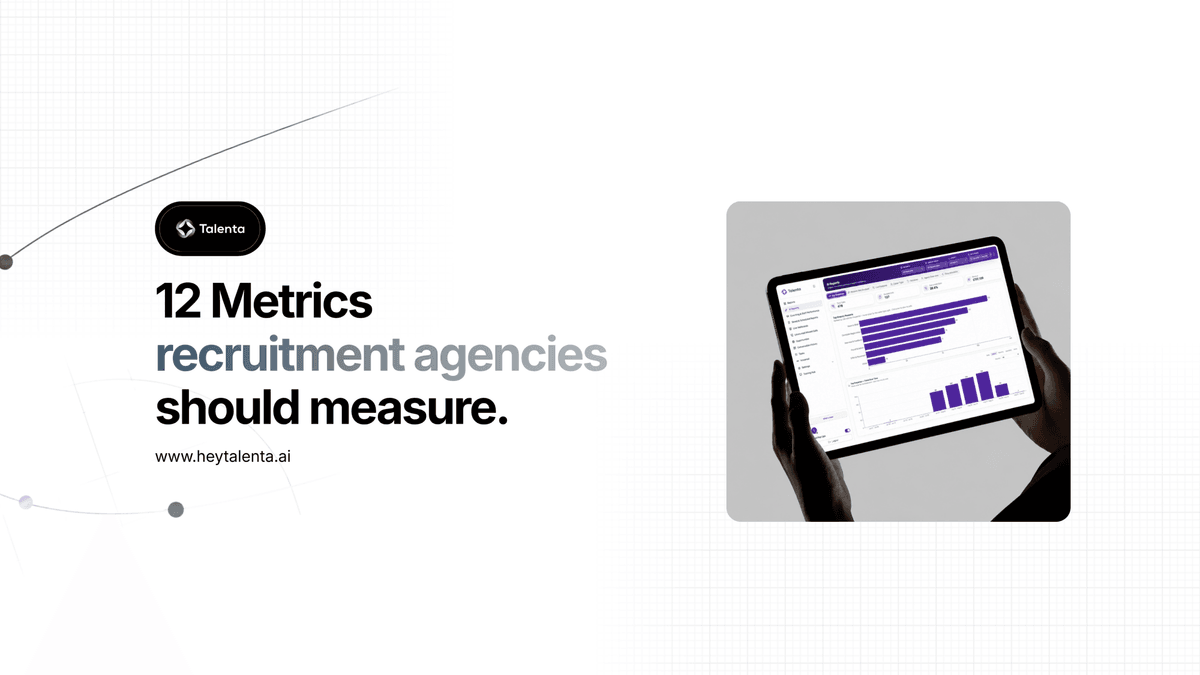
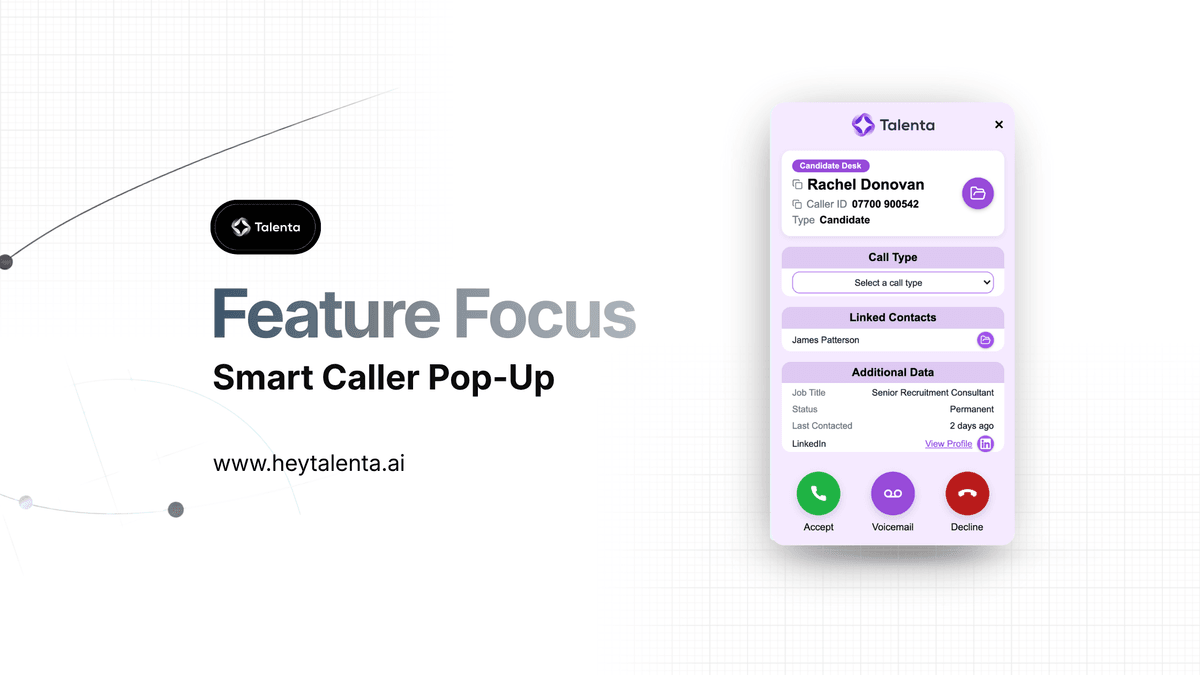
Talenta’s one-click intelligence dashboard brings call data together across consultants and teams, making that pattern visible to leadership rather than buried in individual CRM notes. Any team member or manager can extract candidate or client files from the CRM in a single click. Combine this with smart caller ID, and the agent can have the full context ready on screen before the conversation begins.
The smart caller pop-up stops candidates repeating themselves
The same feature solves the problem of candidates or clients having to repeat their background every time they reach a consultant, saving 30-45 seconds at the start of every call. Because Talenta’s AI phone system recognises the number of any returning caller and pulls up their file on screen, there’s no need to start from scratch every time. The agent can even greet the caller by name, a simple touch whose effect is easy to underestimate.
Turning feedback into action
Capturing feedback is only useful if something happens with it. Whether positive or negative, feedback should trigger a follow-up. If customer sentiment data is scattered across multiple platforms and files, offline and online, it’s harder to spot the patterns and assign the appropriate person to the right person.
By contrast, Talenta enables teams to capture customer sentiment, aggregate the data, spot the patterns, and assign next-steps across the agency, so that even an offhand comment has a chance to become a change in policy.
Discover how Talenta helps your agency capture the feedback you’re missing.
Frequently asked questions
Why don’t recruitment agencies get more formal feedback from candidates and clients?
Formal feedback requests, including surveys, review prompts, exit interviews, rely on people taking extra action after the process is already over. Most candidates and clients don’t. Research suggests fewer than half of HR decision makers have ever been formally asked for feedback on a recruitment agency, even though many have opinions they’d share if asked directly.
Where does most candidate and client feedback actually happen?
Informally, during ordinary phone calls, often in passing, rather than as a direct complaint. A candidate might mention a delay while confirming availability; a client might note a concern while discussing a shortlist.
Can Talenta collect formal feedback surveys?
No. Talenta doesn’t send surveys or collect ratings. It captures and surfaces the feedback already being shared informally on calls, through recording, transcription, summaries and sentiment analysis.
Does sentiment analysis replace a consultant’s judgement?
No. It receives the signal rather than passing a verdict. Sentiment analysis flags calls that may be worth a second look. A manager or consultant still decides what, if anything, needs to happen next.
Can this data show patterns across the whole team, not just one consultant?
Yes. Talenta’s Intelligence Dashboards bring call data together across consultants and teams, which makes it easier to spot a recurring theme than reading individual CRM notes in isolation.